


A graphics card that will not clear the front fan bracket, or a side panel that bows against the power cables, turns a straightforward upgrade into a return label. The listings that matter lead with GPU clearance, airflow path, and radiator room, not with a wall of RGB photos.
I compared the Best PC Cases for Large Graphics Cards by reading the stated clearance figures, checking motherboard and power supply support, and weighing how each layout handles heat from a card that dumps most of its waste into the case. The useful picks state their limits plainly, so you can measure before you order.
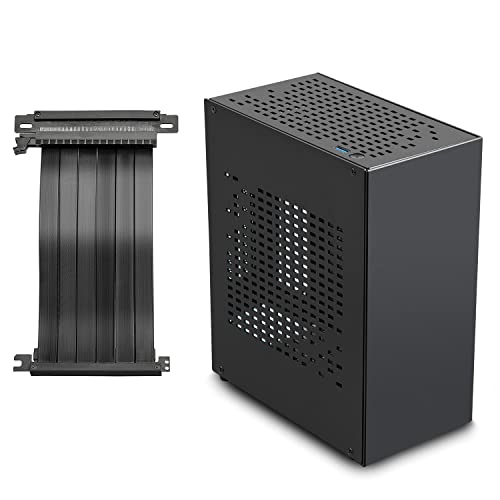
My overall pick for best pc cases for large graphics cards is the Aluminum Mini ITX Case with PCIe 3.0 Riser. It is a small form factor build that still routes a graphics card through an included riser, which suits a compact desk where a full tower will not fit. My top picks are just below.
Best PC Cases for Large Graphics Cards at a Glance
| Product | PGH Score | ||
|---|---|---|---|
|
Best Overall JOYJOM Aluminum Mini ITX Case with PCIe 3.0 Riser | 9.8 | Check Price on Amazon |
|
Best for Dual-Radiator Builds ASUS ROG Cronox E-ATX Full-Tower Case | 9.8 | Check Price on Amazon |
|
Best for Large GPU Builds darkFlash LAND451 ATX Case with Vertical GPU | 9.7 | Check Price on Amazon |

|
Best for Showcase Builds Cooler Master Cosmos Alpha Full Tower Case | 9.6 | Check Price on Amazon |

|
Best for Long GPUs ASUS A32 Plus ATX Gaming PC Case with 4 ARGB Fans | 9.5 | Check Price on Amazon |

|
Best for Compact Builds Cooler Master Q300L V3 Micro-ATX Case with 366mm | 9.4 | Check Price on Amazon |

|
Best for Hidden-Connector Builds ASUS A31 PLUS Black ATX PC Case with Four ARGB | 9.4 | Check Price on Amazon |
In-Depth Reviews
JOYJOM aluminum Mini ITX case with 4.3L capacity, PCIe 3.0 riser, and support for ITX boards, Flex 1U PSU, and GPUs up to 6.7 by 3.9 inches.
Key Facts
- Key Spec
- 4.3L capacity
- Size
- 7.3 x 4.1 x 8.8 inches
- Compatibility
- Standard ITX motherboard, Flex 1U PSU, GPU up to 6.7 x 3.9 x 1.6 inches, CPU cooler under 1.4 inches
- Included
- 1 Mini ITX Case, 1 PCIe 3.0 Riser, Screws
Pros
- +2.0mm aluminum alloy body aids heat dissipation
- +PCIe 3.0 riser cable included for GPU installation
- +Compact 7.3 by 4.1 by 8.8 inch footprint
- +Supports Flex 1U power supplies and two 2.5 inch SSDs
Cons
- −No power supply or case fans included
- −GPU length capped at about 6.7 inches
- −CPU cooler height limited to under 1.4 inches
Detailed Review
The JOYJOM Mini ITX case is a 4.3L aluminum shell measuring 7.3 by 4.1 by 8.8 inches, built around a 2.0mm alloy body rather than stamped steel. I see that alloy choice paying off in a small desk build where the case itself can help move heat away from the board. The included PCIe 3.0 riser lets you mount a graphics card vertically, which is the only way a GPU fits in a chassis this shallow.
Compatibility is tight but clearly defined. It takes a standard 6.7 by 6.7 inch ITX board, a Flex 1U power supply, a GPU up to about 6.7 by 3.9 by 1.6 inches, two 2.5 inch SSDs under 0.35 inches thick, and a CPU cooler under 1.4 inches tall. For my money, that list suits a low-profile air cooler and a short card, not a full-size tower cooler or a long triple-fan GPU.
Two real gaps stand out. No power supply or case fans ship in the box, so budget for a Flex 1U unit and a fan separately, and the 1.6 inch GPU thickness limit rules out most thick aftermarket cards. Builders who want a tiny aluminum shell for a living-room or desk PC will find the size and riser useful, provided the parts list stays within those limits.
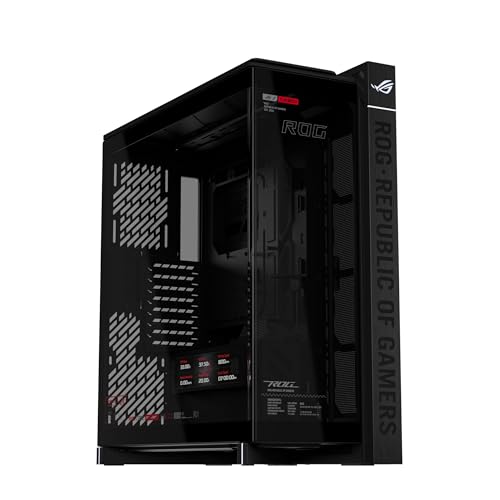
The ASUS ROG Cronox is an E-ATX full-tower case with a curved tempered glass panel, dual 360mm radiator support, and a hinged 9.2-inch LCD screen module.
Key Facts
- Form Factor
- E-ATX Full-Tower
- Max GPU Length
- 400mm
- Radiator Support
- Dual 360mm
- Fan Support
- Up to fourteen 120mm fans
Pros
- +Curved glass and aluminum frame for a panoramic internal view
- +Two 360mm radiator mounts and up to fourteen 120mm fans
- +Graphics card holder and slot clamps support cards up to 400mm
- +Hinged 9.2-inch LCD screen adds live system stats
Cons
- −33.5-pound chassis is heavy to move or reposition
- −Sold without fans, so airflow setup adds cost
Detailed Review
The ASUS ROG Cronox is built around a curved tempered glass panel with an aluminum-trimmed frame, and that curve is the first thing that separates it from a flat-sided tower. Behind the glass, the case takes E-ATX boards plus ATX hidden-connector models, so cable routing stays out of sight rather than crossing the main chamber.
For cooling, the Cronox accepts up to fourteen 120mm fans and two 360mm radiators, and the rotatable side fan bracket lets the airflow channel shift to match the build. A graphics card holder and slot clamps handle cards up to 400mm long, which covers the longest current air-cooled models without sag.
I'd point anyone planning a dual-radiator loop or a hidden-connector board at this case, since those two features drive the layout. The 33.5-pound frame is heavy to move, and fans are not included, so the airflow setup is an added cost.
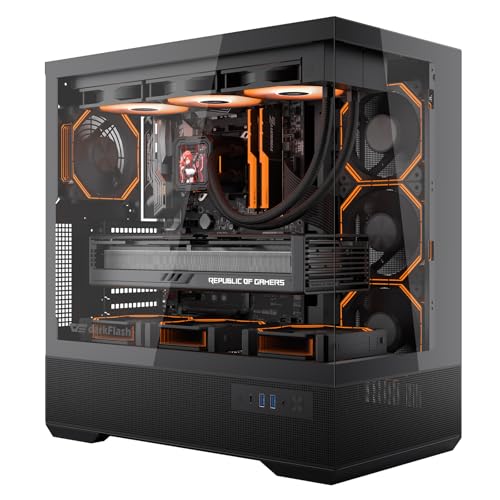
Mid-tower ATX case with dual tempered glass panels, support for 420mm GPUs and dual 360mm radiators, plus a front USB Type-C port.
Key Facts
- Key Spec
- GPU clearance up to 420mm
- Connectivity
- USB Type-C, dual USB 3.0
- Compatibility
- ATX, M-ATX, E-ATX mounting; BTF motherboards
- Size
- 17.76 x 10.16 x 19.33 inches
Pros
- +420mm GPU clearance fits RTX 5090 and oversized cards
- +Dual 360mm radiator support for high-end liquid cooling
- +Rear-connect motherboard compatibility for clean cable routing
- +Front USB Type-C port for modern device connections
Cons
- −Vertical GPU mounting requires a riser cable, not included
- −Weighs about 25 pounds, heavy for frequent moving
Detailed Review
The darkFlash LAND451 is an ATX mid-tower built around a 270-degree dual tempered glass view and support for graphics cards up to 420mm. That length clears an RTX 5090 in either horizontal or vertical orientation, though vertical mounting needs a riser cable that is not included.
Cooling capacity is the other anchor, with room for 360mm radiators on both the top and side panels plus a perforated bottom for vertical airflow. I see this suiting a high-wattage build where a thick radiator and a long card have to coexist.
Rear-connector motherboard support with E-ATX mounting positions keeps cables behind the tray for a cleaner interior. The roughly 25-pound weight is the trade-off, so I would plan the build location before assembly.
Cooler Master Cosmos Alpha full tower case with curved aluminum frame, 400mm GPU support, 420mm AIO support, and ARGB underglow.
Key Facts
- Key Spec
- GPU Clearance: 400mm
- Connectivity
- 4x USB-A 5Gbps, 2x USB-C 20Gbps
- Compatibility
- E-ATX and EEB motherboards, 420mm AIO
- Size
- 26.34 x 13 x 25.16 inches
Pros
- +Rotatable interior allows custom airflow and visual orientation
- +Sliding motherboard tray simplifies air or liquid cooling builds
- +400mm GPU and 420mm AIO clearance for large hardware
- +Front I/O includes two USB-C 20Gbps ports
Cons
- −68-pound weight makes moving or repositioning difficult
- −Full tower footprint demands significant desk or floor space
- −Curved aluminum and tempered glass panels raise cost
Detailed Review
The Cosmos Alpha carries the curved aluminum frame and tempered glass panels of the flagship line, plus ARGB underglow for a showcase build. Its FreeForm 2.0 layout rotates internal components left or right, which matters if you want the GPU facing a certain way on a desk.
The sliding motherboard tray lets me shift GPU distance for airflow tuning, and the case clears 400mm graphics cards and 420mm AIO radiators. Two USB-C 20Gbps ports sit on the front I/O for fast external drives.
At 68 pounds, this is a stationary build, not something to move often. I would suggest it for a permanent showcase or workstation where the footprint and weight are planned for.
ASUS A32 Plus is a dual-chamber ATX case with four pre-installed ARGB fans, front USB-C, and room for 360mm radiators and 420mm graphics cards.
Key Facts
- Form Factor
- ATX, Micro-ATX, Mini-ITX
- Max GPU Length
- 420 mm
- Max CPU Cooler Height
- 165 mm
- Radiator Support
- Top 120/240/360 mm, Rear 120 mm, Bottom 120/240/360 mm
Pros
- +Four ARGB fans included, no extra fan purchase needed
- +420mm GPU clearance covers long triple-fan cards
- +360mm radiator support on top and bottom mounts
- +Front USB 10Gbps Type-C port for fast device hookups
Cons
- −No fans listed for rear exhaust position
- −Tempered glass panels need careful handling during builds
Detailed Review
The A32 Plus splits its interior into two chambers, which keeps CPU heat and graphics card heat from sharing one airflow path. Four ARGB fans come pre-installed, so a fresh build gets lighting and airflow without a separate fan order. The front panel adds a USB 10Gbps Type-C port, which suits anyone with a modern board header and a phone or drive that uses the smaller connector.
Clearance is the headline number here. A 420mm graphics card limit covers the longest triple-fan models, and the 165mm cooler height handles most tower air coolers. Radiator support runs up to 360mm on the top and bottom, with a single 120mm spot at the rear.
For a mid-tower build around $110, I'd point this at anyone running a long GPU who wants the glass-panel look without buying fans separately. The rear exhaust spot sits empty, so plan a fifth fan if you want a full push-pull layout.
Micro-ATX case with tempered glass, support for 366mm graphics cards and 240mm AIO radiators, plus six fan mounts for airflow.
Key Facts
- Key Spec
- 366mm GPU Clearance
- Compatibility
- Micro-ATX Motherboards
- Size
- 15.2 x 15.3 x 12.6 inches
- Weight
- 10 pounds
Pros
- +366mm GPU clearance fits most current gaming graphics cards
- +Six fan mounts plus 240mm radiator support for airflow
- +Movable I/O panel adapts to desk or floor placement
- +Magnetic dust filters simplify cleaning in dusty rooms
Cons
- −Micro-ATX form factor limits motherboard choices versus ATX cases
- −Tempered glass side panel shows dust and fingerprints easily
Detailed Review
The Q300L V3 centers on a 366mm graphics card clearance, which covers most current RTX and Radeon cards without forcing a mid-tower. I would point builders toward it when a compact footprint matters more than room for a full ATX board. Six fan mounts and 240mm radiator support give real airflow headroom for a small case.
Cooler clearance tops out at 178mm, so most tower air coolers still fit alongside a 200mm ATX power supply. The movable I/O panel is a practical touch for desk or floor placement, and magnetic dust filters cut down on cleaning. My reservation is the Micro-ATX limit, which rules out full ATX motherboards and their extra PCIe slots.
The ASUS A31 PLUS is a black ATX case with four pre-installed ARGB fans, dual tempered glass panels, and support for 380mm graphics cards and 360mm radiators.
Key Facts
- Key Spec
- Four pre-installed ARGB fans
- Compatibility
- Hidden-connector motherboards
- Size
- 20.12 x 9.37 x 17.13 inches
- Weight
- 18.07 pounds
Pros
- +Four ARGB fans included for immediate cooling and lighting
- +Dual tempered glass panels for unobstructed component views
- +Supports 380mm graphics cards and 360mm radiators
- +Hidden-connector motherboard support simplifies cable routing
Cons
- −Weighs 18.07 pounds, cumbersome to move or transport
- −No front-panel USB-C port mentioned in specifications
- −Limited to 165mm CPU air cooler height
Detailed Review
The ASUS A31 PLUS arrives with four pre-installed ARGB fans and dual tempered glass panels, a combination that covers airflow and showcase in one box. For builders using a hidden-connector motherboard, the case is designed to route cables behind the tray for a cleaner look.
Clearance is generous, with room for graphics cards up to 380mm and radiators up to 360mm with 80mm-thick fans. I see this fitting a mid-tower build where a large graphics card and a front-mounted radiator need to coexist without compromise.
The 8-degree angled base is intended to improve airflow and viewing angle, though the 18.07-pound weight makes it a stay-put case. CPU air coolers are capped at 165mm, so tall tower coolers need checking against that figure before purchase.
FAQs
How do I know a case will fit my graphics card?
Measure your card’s length and compare it to the case’s stated maximum GPU length, then confirm the thickness and slot count against the manufacturer’s spec sheet. A card that clears the bracket can still foul a front radiator or a side fan mount, so check the full clearance diagram before ordering.
Does a bigger case run cooler?
More internal volume helps only when air actually moves through it, so a full tower with blocked intakes can run warmer than a compact case with a clear front mesh. Fan count and intake placement matter more than raw size for a card that exhausts into the case.
Can a Micro-ATX case hold a modern high-end GPU?
Several Micro-ATX cases list support for cards well past 350mm, which covers most current flagship models. The catch is usually power supply length and cable room behind the card, so check those two figures alongside GPU clearance. A compact build also benefits from a case with strong front airflow to keep intake air moving.
What power supply wattage do I need for a large graphics card?
Check the graphics card maker’s recommended power supply wattage and the connectors the card needs, then match that to a unit with the right cables. Use only the cables that came with that power supply, since mixing cables from another unit can damage components. Case length limits for the PSU matter too, so measure before buying.
Final Thoughts
For a large graphics card, the deciding numbers are GPU clearance, intake airflow, and radiator room, and everything else is preference. The Aluminum Mini ITX Case with PCIe 3.0 Riser is my overall pick because it fits a full-size card into a small footprint through an included riser, which suits a compact desk or a living room build where a tower would dominate the space. If you want to spend less, the Cooler Master Q300L V3 Micro-ATX PC Case lists support for cards up to 366mm in a compact Micro-ATX layout, and its magnetic dust filters and movable I/O panel make it easier to live with over time.
Skip the small form factor route if you plan on a triple-slot card with a thick backplate, since the listed clearance is tight and cable routing gets cramped. A full tower makes more sense for dual radiators and a vertical mount. If you are still mapping out the rest of the build, PC components and compatibility covers how the parts fit together before you commit. Check the current price on Amazon, and the right case removes the guesswork about whether your card actually fits.
